If you are going through a divorce in California, you’re probably wondering how to find a good divorce lawyer. We put together this comprehensive list to help you from the moment you begin your search through the time you actually retain an attorney.
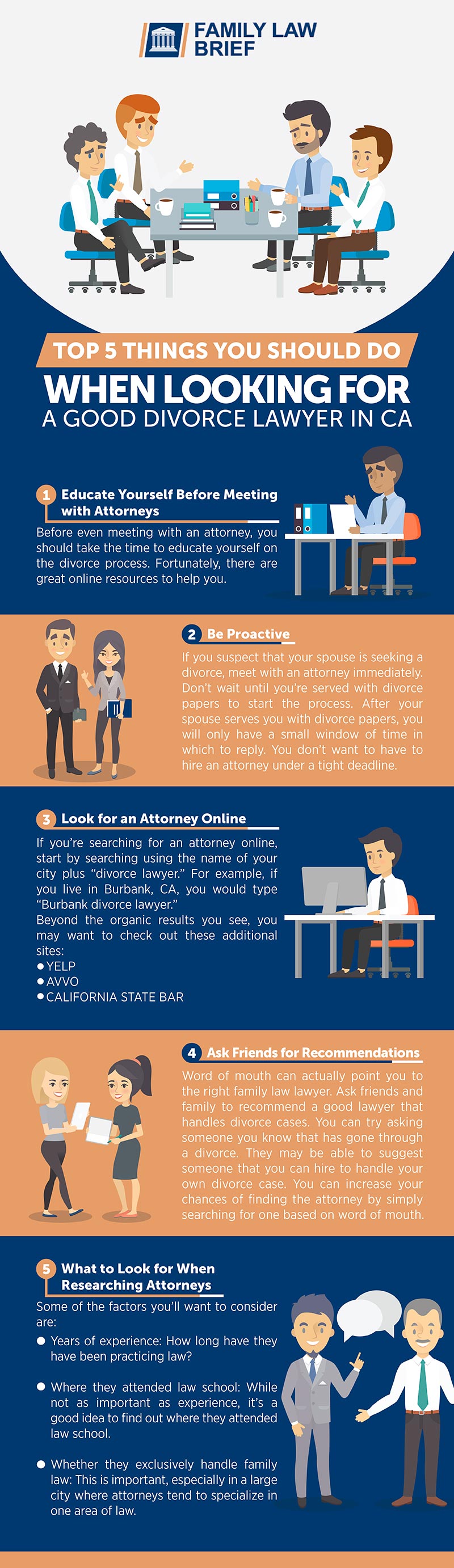
1. Educate Yourself Before Meeting with Attorneys
Before even meeting with an attorney, you should take the time to educate yourself on the divorce process. Fortunately, there are great online resources to help you. We asked Los Angeles divorce lawyer Hossein Berenji for the top three sites he recommends. He suggested:
A. California Courts – Divorce and Separation Self-Help
This website, provided by the State of California, provides an excellent overview and resources for those seeking a divorce.
B. California Courts – Filing for Divorce
This website, also provided by the State of California, gives you step-by-step info regarding the divorce process. Even though you may be hiring a family law attorney, it helps to know the process.
C. State Bar of California – What Should I Know About Divorce and Custody
This information is provided by the State Bar of California, the administrative arm of the California Supreme Court overseeing attorney conduct. This FAQ covers important information that will help you get started on your divorce.
2. Be Proactive
If you suspect that your spouse is seeking a divorce, meet with an attorney immediately. Don’t wait until you’re served with divorce papers to start the process. After your spouse serves you with divorce papers, you will only have a small window of time in which to reply. You don’t want to have to hire an attorney under a tight deadline.
3. Look For An Attorney Online
If you’re searching for an attorney online, start by searching using the name of your city plus “divorce lawyer.” For example, if you live in Burbank, CA, you would type “Burbank divorce lawyer.”
Beyond the organic results you see, you may want to check out these additional sites:
YELP: Yelp is a great place to read about attorneys. While you should always take online reviews with a grain of salt, it’s a starting point when researching attorneys. Make sure you don’t simply look at how many stars they have, but take the time to read the actual reviews – both good and bad. See more: https://www.yelp.com
AVVO: Avvo is another great place to research attorneys. Beyond the reviews and peer endorsements, Avvo tells you if the attorney has ever been disciplined by the State Bar for violating the California State Bar Rules of Professional Conduct. See more here: https://www.avvo.com
FINDLAW: FindLaw is another legal directory that you’ll usually see high in the search results. Beyond attorneys, you’ll also find informative articles related to divorce and family law. See more here: https://www.findlaw.com
CALIFORNIA STATE BAR: The State Bar website provides information on attorneys and also offers a referral service. If the attorney has been disciplined, you can find out more by visiting their profile. You can also search for an attorney by visiting here. See more: http://www.calbar.ca.gov
4. Ask Friends For Recommendations
Word of mouth can actually point you to the right family law lawyer. Ask friends and family to recommend a good lawyer that handles divorce cases. You can try asking someone you know that has gone through a divorce. They may be able to suggest someone that you can hire to handle your own divorce case. You can increase your chances of finding the attorney by simply searching for one based on word of mouth.
5. What to Look For When Researching Attorneys
Some of the factors you’ll want to consider are:
- Years of experience: How long have they have been practicing law?
- Where they attended law school: While not as important as experience, it’s a good idea to find out where they attended law school.
- Whether they exclusively handle family law: This is important, especially in a large city where attorneys tend to specialize in one area of law.
A lawyer that is experienced in family law should be your first choice. You should not look into a lawyer that handles real estate, or even a criminal defense attorney. Always go for a family law lawyer. By doing so, you will get their knowledge and expertise when it comes to divorce law.
6. Hire a Specialist
Depending on the complexity of your case, you may want to hire a Certified Family Law Specialist. A CFLS is certified by the California State Bar as a specialist in that particular area of law. Typically, you can expect a CFLS to charge a higher hourly rate than a non-CFLS.
Again, it may not be necessary unless your divorce involves more complex property division or custody matters.
7. Meet with at Least 2 – 3 Attorneys
Shop around for a competent divorce lawyer. You should not settle on the first one that you find. It can be a good idea to set up meetings with at least two or three other lawyers, especially if you want to find a competent one. You can canvas different kinds of lawyers, to get a sense of their different skill sets. By interviewing many divorce lawyers, you may be able to select the best one out of the bunch.
Many family attorneys now offer a free consultation. Use this time to essentially interview different attorneys. Discuss your case and get feedback. You shouldn’t always go with the attorney that tells you what you want to hear, but rather what you need to hear.
8. Questions to Ask a Divorce Attorney Before Hiring
Here are a few questions you should consider asking during the initial consultation.
A. How much do you charge per hour?
B. Do you have a “blended” rate (If yes, what is it?).
C. How much do you estimate my case will cost?
D. Are you familiar with opposing counsel?
E. Have they handled cases in front of the judge assigned to me? (If a judge has been assigned).
F. Will you be the only person working on my case? (If not, see below).
G. Who will be working on my case? (Get their experience)
H. Can I meet any associates that will be working on my case besides you?
I. During what hours can I call you?
J. What if I need to contact you in the event of an emergency?
K. Will I receive monthly bills?
L. How much is your initial retainer?
M. How do you bill per hour? In 6 minute increments?
9. Be 100% Honest
Attorneys throughout the United States are bound by what is known as attorney-client privilege. Even if you don’t retain them, they are bound by attorney-client privilege regarding whatever was said during the meeting. In California, attorney-client privilege provides almost absolute protection against an attorney disclosing what was said during the consultation.
People have a tendency to paint a one-sided picture during the initial consultation. While attorneys know this, it’s best to be 100% honest from the start. Remember, attorney-client privilege protects you regardless if you retain the attorney.
10. Personality Fit
A. Do you get along?
This is a simple one. Did you enjoy your meeting with them? Did you feel comfortable telling them about your situation. You don’t have to be best friends with your attorney, but it’s preferable to hire an attorney that you get along well with.
B. Did they pressure you to retain them?
If yes, you may want to hire someone else. While an attorney has to make a living, they are in a position of authority and shouldn’t be pressuring you to retain them.
11. Location
As they say, law is local. You therefore want an attorney who is local to court where your case is being heard. A local attorney will know the judges, attorneys, and experts.
Don’t hire an attorney because their office is conveniently located by where you live and/or work. Hire an attorney that is local to the court where you case is being heard.
12. Law Office Appearance and Professionalism
This one is simple. If their office is dirty and their staff unfriendly, don’t expect that to change after you hire them. If they can’t be professional before you give them your money, they are unlikely to be professional after taking your money.
13. Understand the Scope of the Divorce
Before going down the path of divorce, you should try to understand the scope of your divorce. What are the issues at stake?
- Custody
- Support (child and/or spousal), and
- Property Division
Knowing the contested issues will give you a better idea of what to expect in terms of time, money, and stress.
In Closing
By following these guidelines, you should be able to hire a very reliable and competent divorce lawyer. If you want to go through the least amount of trouble when you are undergoing a divorce, you should look into hiring one. A divorce lawyer’s services could be invaluable whenever you are going through a divorce. And you may be able actually to go through a pain-free divorce if you hire the right kind of lawyer to handle your case.
Do not hesitate to contact the services of a divorce lawyer if you find one that you can trust, you will be making a very good decision if you hire them.
Read More










Recent Comments